
Central processing unit (CPU)
A central processing unit (CPU) is also called processor, microprocessor. This is the most important part of the computer. It fulfills all the important functions of the computer. It process the data. Whatever instructions we give to the computer, it is the job of the CPU to execute them. CPU does all the calculations and data manipulation. It executes the instruction and provides output. CPU also controls all the operations of the computer.
CPU also helps in communicating all the devices. It translates all the instructions as we type on the keyboard, click with the mouse, or move the mouse.
The CPU takes care of all the devices being able to communicate with each other.
That is why we call CPU as the “brain of the computer”.
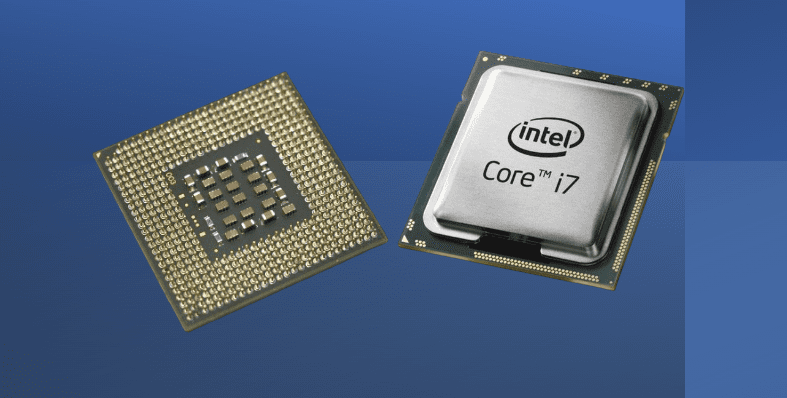
Components of CPU
- ALU(Arithmetic and logical unit)
- CU (Control Unit)
- Memory or Storage unit
1.) ALU (Arithmetic and logical unit)
ALU is the component of CPU that performs arithmetical and logical operations of the computer. It performs addition, subtraction, multiplication, division, comparison.
It consist of two subparts: –
i.) Arithmetic part
ii.) Logical part
- Arithmetic Part: – It is the part of ALU that performs arithmetical work means mathematical work. It performs addition, subtraction, multiplication, and division. It also pereforms complex problems by repeatedly perform mentioned operation.
- Logical Part: – It is the part of ALU that performs logical tasks. Logical tasks means comparing, selecting, and matching.
2.) CU(Control unit) : – CU is the component of CPU that controls the flow of data, and all other parts of computer. It takes instructions from memory, decode the instruction and also execute. It maintains the flow of instructions within the CPU. It performs four task: –
- Fetch: – It means, retrieving instructions from the memory(RAM). Instructions is retrieved with the help of PC(Program counter register) that stores the memory address of next instruction.
- Decode: – After fetching instructions from the memory, CU then decodes it means interpreting the instruction that what operation should be done and on which data the operation will be performed.
- Execute: – After decoding, CU further pass that decoded data to the ALU for perform arithmetic or logical operation. The ALU perform the specified operation.
- Store: – It saves the data for later use. CU sends processed data to the memory for storage purpose so that data can be stored permanently.
3.) Memory or Storage unit
Memory unit is used to store the data. It has the ability to store large amount of data permanently or temporarily.
There are mainly two types of memory: –
- Primary memory: – Also called main memory of the computer. It stores data temporarily. It communicates directly with CPU. Ex. RAM, ROM
- Secondary memory: – It can store huge amount of data permanently. It does not communicate directly with CPU. Ex. SSD, HDD, Pendrive etc.
Clock speed of the CPU
Also known as CPU clock rate. It means how many instructions a CPU can process in a second. Normally, It is measured in megahertz(MHz) and gigahertz (GHz). 1 MHz means 1 million ans 1 GHz means 1 billion. For example if our CPU has the clock speed of 3 GHz that’s means our CPU can process 3 billion instructions within a second.