
Registers vs Primary Memory
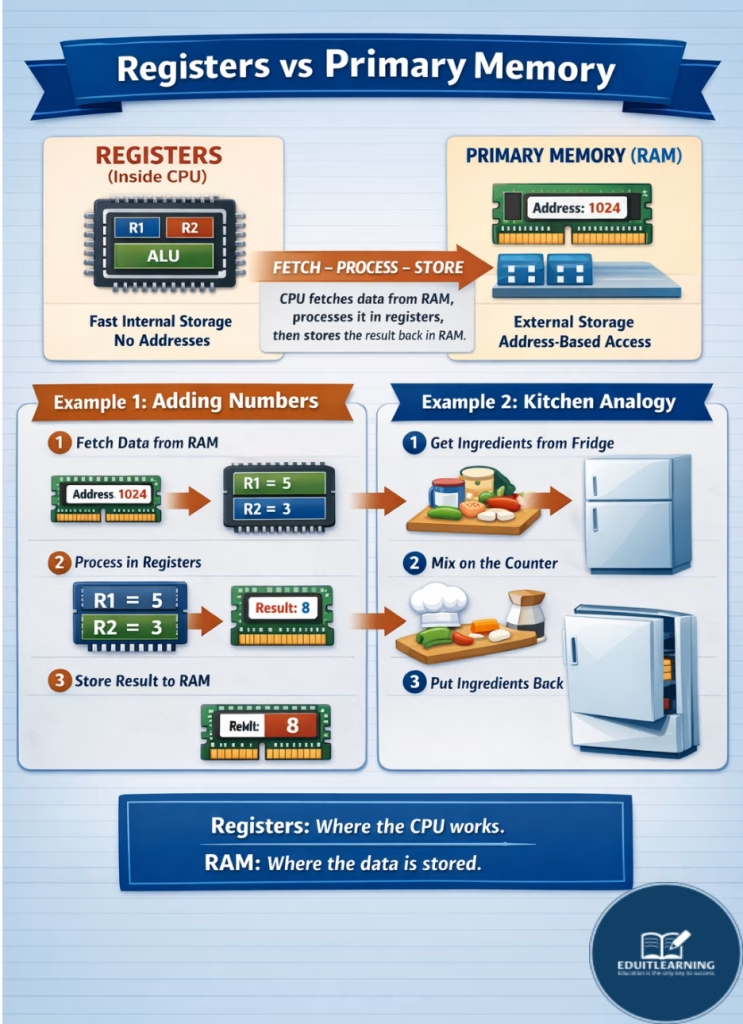
Primary memory is the memory that the CPU accesses directly using memory addresses. It stores the data and instructions required to run programs.
Registers fit this idea because they are inside the CPU, accessed directly, and hold the data and instructions currently being processed.
So, registers can be considered primary memory.
But look in it:
In CPU architecture, registers and primary memory are treated as separate components.
Registers are small storage locations located inside the CPU. The CPU accesses them internally and does not use memory addresses to identify registers.
Primary memory, commonly known as RAM, exists outside the CPU. Every data item stored in RAM has a unique memory address. The CPU uses these addresses to locate and fetch data.
Memory Address
A memory address is a unique location number used by the CPU to identify and access data stored in RAM. Registers do not have memory addresses because the CPU already has direct internal access to them.
The CPU follows a fixed sequence during program execution:
- Data is fetched from RAM using memory addresses
- The fetched data is loaded into registers
- All computations are performed using register values
- The result is written back to RAM when required
Example-1
When the CPU needs to add two numbers, it first fetches both numbers from RAM using their memory addresses.
These values are loaded into registers such as R1 and R2. The addition operation is performed inside the CPU using these registers.
The final result is stored in another register and then written back to RAM if the program needs to store it.
Example-2
RAM functions like a refrigerator that stores all ingredients. Each ingredient has a fixed location, similar to a memory address.
The CPU functions as a cook.
Registers function as the ingredients placed on the kitchen counter.
Process:
- The cook retrieves ingredients from the refrigerator using their fixed locations
- Required ingredients are placed on the counter
- All work is performed on the counter
- Unused ingredients are returned to the refrigerator
Conclusion
Primary memory provides address-based access to data, while registers provide the fastest internal storage for immediate processing. The CPU does not perform operations directly on RAM. Instead, it fetches data from RAM using addresses, loads it into registers, performs all operations within the registers, and stores the result back into RAM when required.
This distinction explains why registers and primary memory serve different roles in CPU architecture, even though both are essential for program execution.